Why Your Brain Secretly Loves Every Single Stitch
At first glance, cross stitch looks simple: tiny X’s on fabric, one after another. Calm, repetitive, almost meditative.
But beneath that quiet surface?
A full orchestra of cognitive processes, emotional rewards, and surprisingly sophisticated mental strategies.
Let’s take a look at what’s really happening in your mind while you stitch.
🧠 1. The Brain Loves Structure (and You’re Feeding It)
Your brain is a pattern-detection machine. It craves order.
Cross stitch delivers:
- grids
- symbols
- repeatable rules
Every time you match a symbol to a color and place it correctly, your brain gets a small reward signal: “Yes. This makes sense.”
This taps into what psychologists call cognitive fluency — the pleasure we feel when something is easy to process and structured.
👉 Result: calm focus, reduced mental noise, satisfying clarity.
🔁 2. Repetition = Regulation
Those thousands of tiny stitches? They’re not boring—they’re regulating.
Repetitive, low-risk actions:
- reduce stress
- stabilize attention
- create rhythm
This is closely related to self-soothing behavior. Similar to walking, knitting, or even breathing exercises.
Your nervous system shifts:
- from alert → to steady
- from chaotic → to controlled
👉 That’s why stitching can feel almost meditative without trying to be.
🎯 3. Patience Is Not Passive — It’s Active Control
Cross stitch trains a very specific psychological skill: delayed gratification.
You don’t get instant results.
You get:
- one stitch
- then another
- then 10,000 more
Your brain learns:
“Progress is happening, even if I can’t see the full picture yet.”
This strengthens:
- persistence
- frustration tolerance
- long-term thinking
👉 In psychological terms: you’re literally training executive function.
🔢 4. Yes, There’s Math Involved (And Your Brain Knows It)
Even if you don’t think “I’m doing math,” you are.
Constantly.
- counting stitches
- estimating distances
- tracking position
- correcting errors
This activates:
- working memory
- spatial reasoning
- error detection systems
And here’s the interesting part:
Because it’s embedded in a creative task, your brain experiences it as fun, not effort.
👉 Hidden math = engaged cognition without resistance.
🔍 5. Symbol Recognition = Micro Problem Solving
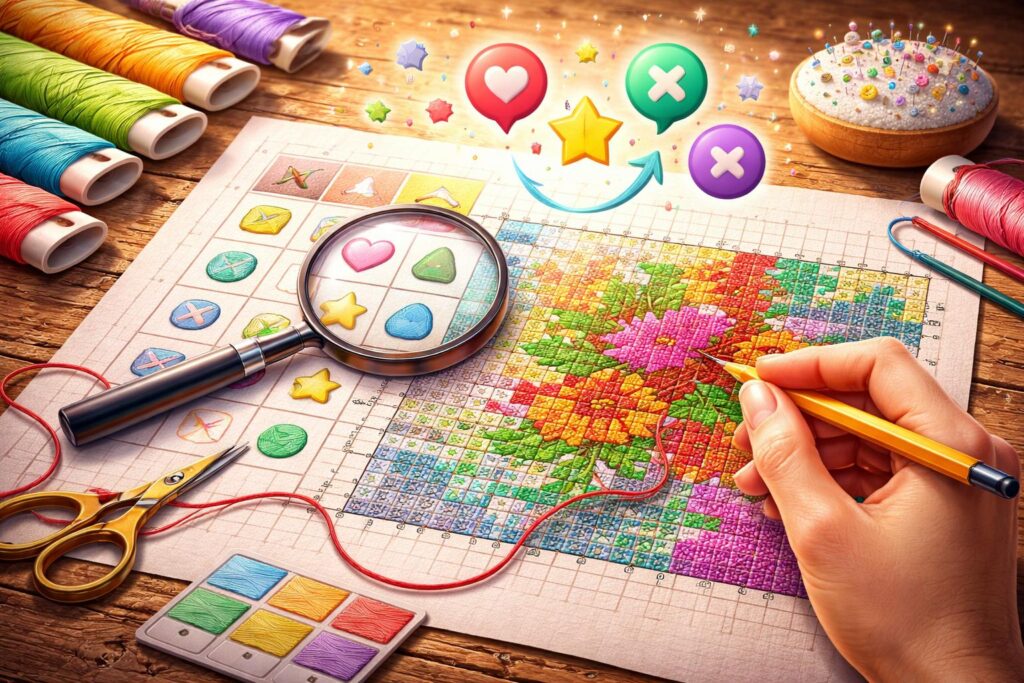
A cross stitch chart is essentially a coded system.
You continuously:
- decode symbols
- map them to colors
- translate them into action
This is a form of pattern recognition and symbolic processing—similar to reading music or learning a language.
Your brain builds efficiency over time:
- faster recognition
- fewer mistakes
- smoother execution
👉 You’re becoming a highly specialized decoding machine.
🧵 6. Strategy: Yes, You’re Developing One
Every stitcher eventually forms preferences:
- cross-country vs. parking
- light to dark vs. section-based
- outline first vs. fill later
This is not random.
It’s your brain optimizing:
- effort
- error probability
- visual feedback
👉 In psychology, this is called procedural learning—developing efficient methods through experience.
💬 7. Community: Shared Obsession, Shared Meaning
Cross stitching might look solitary—but psychologically, it’s deeply social.
Through:
- forums
- groups
- shared patterns
- progress photos
you participate in a community of practice.
This provides:
- validation (“others do this too”)
- identity (“I’m a stitcher”)
- motivation (“look what they achieved”)
👉 Humans are wired for belonging—even in quiet hobbies.
🎨 8. The Deep Satisfaction of Creating Beauty
There’s a powerful psychological reward in making something visibly beautiful.
Especially when:
- it starts as chaos (fabric + thread)
- and becomes order (an image)
This taps into:
- aesthetic reward systems
- intrinsic motivation
- creative fulfillment
And importantly:
You didn’t just consume beauty. You created it.
👉 That distinction matters deeply for long-term satisfaction.
🔄 9. Flow: The Hidden State You Slip Into
Ever stitched for “just 10 minutes”… and suddenly it’s two hours later?
That’s flow.
A psychological state where:
- challenge matches skill
- distractions fade
- time distorts
Cross stitch is perfectly calibrated for this:
- clear goals
- immediate feedback
- manageable complexity
👉 Flow is one of the most rewarding mental states humans can experience.
🧠 10. Loyalty, Identity, and “Your Way” of Stitching
Over time, something subtle happens.
You develop:
- preferences
- habits
- a style
You might say:
- “I always start in the center”
- “I only use two strands”
- “I trust this brand”
This is identity formation.
👉 You’re no longer just stitching.
You’re becoming a stitcher.
✨ Final Thought: Why It Feels So Good
Cross stitch sits at a rare intersection:
- structured but creative
- repetitive but meaningful
- simple but cognitively rich
It engages:
- your hands
- your eyes
- your brain
- your emotions
All at once. In harmony.
And that’s why, stitch by stitch, it does something quietly powerful:
👉 It brings order to your mind—while you create something beautiful in the world.
Happy stitching — and now you know what your brain is really up to 😉
— CrossStitchFreak